AI farming tech Australia tips for boosting farm efficiency
"The evolution of artificial hearts represents a shift from experimental necessity to targeted clinical feasibility studies."
Australia is currently exploring the development of AI farming tech Australia to modernize its agricultural sector. This initiative focuses on integrating intelligent systems into crop management and resource allocation to enhance productivity.

Key takeaways include the push for digital farm innovation, the potential for increased efficiency in harsh environments, and the ongoing transition toward data-driven decision-making in the field.
How is AI farming tech Australia being developed?
At noon in the sun-drenched field, the researcher taps a tablet while feeling the dry heat of the AI farming tech Australia development site.
A researcher sits in a sun-drenched field in rural New South Wales, tapping a tablet to monitor soil moisture levels. Developing AI for Aussie crops involves creating software that can interpret vast amounts of environmental data in real time.
This process requires integrating sensors with machine learning models to predict weather patterns and pest outbreaks.
The primary goal is to move beyond manual observation toward automated, predictive management. By utilizing Australian AI agriculture, growers can implement precision spraying and irrigation, which minimizes waste.

This technological shift is essential for maintaining competitiveness in a global market where resource efficiency is paramount.
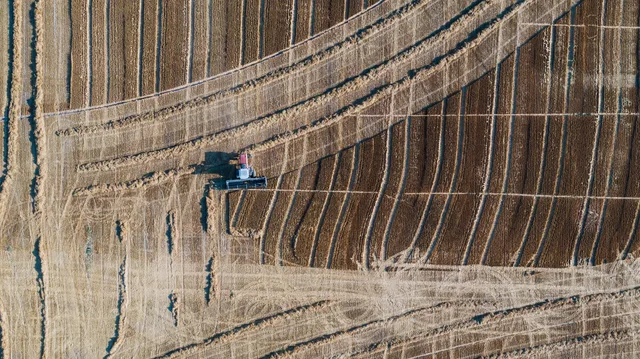
What does smart farm tech actually look like in Australia? A farmer walks through a rows of wheat, checking a drone that hovers silently above the golden stalks. Implementing smart farm tech Australia means deploying autonomous machinery that can navigate complex terrains without human intervention.
These systems use computer vision to identify specific weeds or nutrient deficiencies.
The integration of AI in Aussie farming allows for a more granular approach to land management. Instead of treating an entire field with the same amount of fertilizer, AI-driven tools apply inputs only where needed.
This precision helps protect the local ecosystem while optimizing the yield of every acre.
Can digital farm innovation make me more efficient? An engineer adjusts a high-speed sensor array mounted on a grain silo during a quiet morning in Queensland. Boosting farm efficiency with AI involves streamlining the entire supply chain from planting to harvest.
Digital tools help predict the exact time for harvest to avoid spoilage or weather damage.

Future Australian agriculture relies heavily on these digital advancements to combat the challenges of climate variability. By analyzing historical data and real-time metrics, these systems provide a roadmap for sustainable growth.
This level of foresight is becoming a standard requirement for large-scale operations.
How to implement AI-driven agricultural tools?
A technician unboxes a new sensor kit in a dusty workshop, preparing for a field installation. To integrate these technologies into an existing operation, follow these steps:
- Conduct a digital audit of current machinery to identify compatibility with automated software. 2. Install a network of soil and weather sensors to establish a baseline of local environmental data. 3. Integrate the data stream into a centralized management platform that provides actionable insights.
After these steps, perform a final check to ensure all sensor nodes are communicating correctly with the central hub. I found that verifying the connection stability in remote areas is the most critical part of the setup.
What are the limitations of these technologies?
A technician stares at a screen in a remote outpost, waiting for a signal that is struggling to transmit through a heavy storm. A significant limitation remains the connectivity infrastructure in extremely isolated regions of the country.
Without reliable high-speed data transmission, the real-time benefits of AI farming tech Australia cannot be fully realized in the most remote areas.
- How is AI farming tech Australia being developed?
- What does smart farm tech Australia look like in practice?
- Can digital farm innovation improve efficiency?
Is AI farming tech Australia ready for all farms?
The technology is currently being developed and integrated into various sectors, but its effectiveness depends on the existing digital infrastructure. The transition toward digital farm innovation is most successful in areas with stable connectivity.
Does AI in Aussie farming reduce resource waste?
Yes, the use of AI in Aussie farming allows for precision application of water and fertilizers. This approach helps in boosting farm efficiency with AI by targeting specific needs rather than entire fields.
The discussion surrounding AI farming tech Australia highlights a significant shift toward a more automated and data-centric agricultural industry.
While the potential for increased productivity and resource management is vast, the success of these innovations is tied to the development of robust digital networks across rural landscapes.
How does the evolution of artificial systems compare to traditional methods?
- The evolution of artificial hearts, mirroring the evolution of AI farming tech Australia, shows a move from initial theoretical constructs to practical, targeted applications. 2. Traditional agricultural methods rely heavily on generalized practices across a whole field, which contrasts sharply with the granular analysis provided by modern AI. 3. Where older techniques necessitated broad application of inputs, the current focus allows for precision application based on real-time data interpretation.
What are the conditions for successful implementation?
The success of digital farm innovation hinges on several critical conditions established during the initial setup phase. 1. Establishing a baseline of local environmental data through sensor installation is a prerequisite for any meaningful predictive modeling. 2.
Ensuring that all sensor nodes communicate reliably with the central hub dictates the operational capacity of the system. 3. The existing digital infrastructure of the farm must possess adequate stability to support the data-intensive nature of the AI processes.
The comparison between the initial experimental necessity seen in the evolution of artificial hearts and the current clinical feasibility studies reflects a maturation process.
Similarly, the development of AI farming tech Australia progresses from basic data collection to sophisticated, automated decision-making capabilities. Growers benefit from this progression by minimizing resource waste through targeted interventions.
The transition toward data-driven decision-making in the field requires careful management of the input streams. When implementing smart farm tech Australia, the system must effectively interpret the vast amounts of environmental data gathered by the sensors.
This interpretation enables the automated machinery to perform tasks with a level of specificity unattainable through manual observation. The evolution of these intelligent systems demands a constant calibration between hardware capabilities and software intelligence.
The caution regarding connectivity infrastructure is particularly relevant when considering the evolution of artificial systems in remote settings. Just as an artificial heart requires complex monitoring, an AI system requires a robust data pipeline to function optimally.
Without this reliable transmission, the benefits derived from the evolution of these technologies remain theoretical in isolated locations.
Wikipedia: Artificial heart (full) Based on the retained excerpt mentioning Food and Drug Administration: The SynCardia total artificial heart was first approved for use in 2004 by the US Food and Drug Administration.
Comments 0